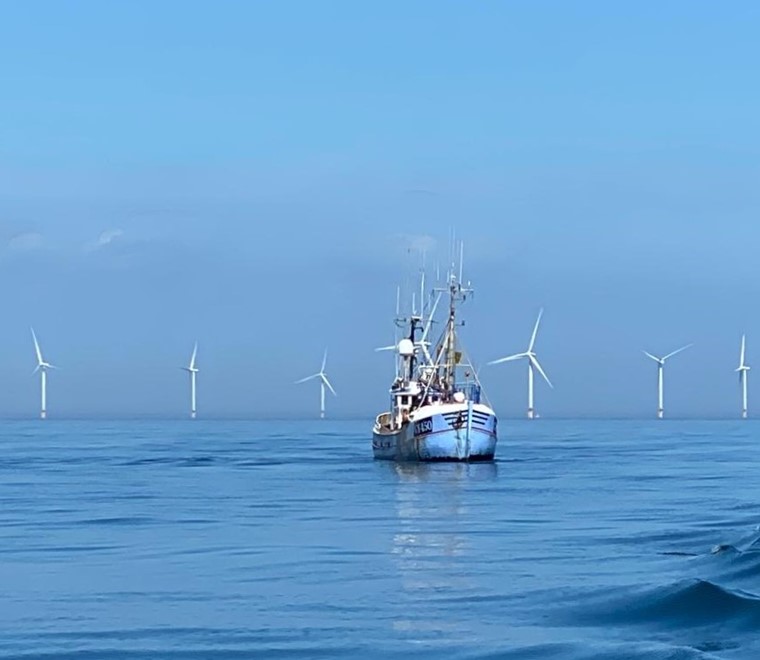
Enabling cross-sector engagement: fisheries and offshore renewable energy
Supporting Best Practice Guidance to foster mutual coopration between fisheries and offshore renewables
Learn more

To inform future policy decisions around assigning bluefin tuna quota, the Department for Environment, Food & Rural Affairs (Defra) sought to understand how costs and benefits of bluefin tuna fishing are distributed across different commercial and recreational fisheries and scales (individual, local, town, etc.).
In 2023, Defra commissioned ABPmer and Risk & Policy Analysts (RPA) to evaluate and compare the socio-economic value of the bluefin tuna fishery in English and Scottish waters, based on two trial fisheries.
The trial was evaluated again in 2024 – 2025, to help inform decisions on how bluefin tuna quota is managed in the future. This updated evaluation considers the expanded bluefin tuna recreational fishery for 2024, and the changes in commercial quota allocation since 2023.
This latest evaluation focussed on two trial fisheries:
The commercial fishery, which accessed the tuna through 13 trial licences
The catch-and-release recreational fishery (CRRF), involving 90 charter and private vessels
ABPmer led on the commercial fisheries evaluation.
The commercial fishery evaluation used secondary data from the Marine Management Organisation (MMO), supplemented by face-to-face engagement with fishers and downstream operators. Three critical success factors were established to determine the scope of evaluation:
1. Optimising quota use in both fisheries
2. The social and economic benefits of the trial to coastal communities
3. Develop best-practice guidance to inform future commercial trials applications
A benefits framework and socio-economic indicators were updated from the 2023 evaluation to provide comparable data for both years.
The UK had 66.15 tonnes of bluefin tuna quota for 2024. The MMO distributed 39 tonnes of the quota for use in a trial commercial fishery. Licences were distributed to 13 commercial fishing vessels to fish and land up to three tones of tuna each, using rod and reel gear. Five licence holders had previously participated in the 2023 fishery, whilst eight were new participants.
The total direct economic impact of the commercial bluefin tuna fishery in 2024 was £392,007, with a potential impact of £470,500 if all 39 tonnes of quota had been landed.
The economic impact (direct and indirect) of the fishery in 2024 was £713,000, with a potential economic impact of £856,000 if all 39 tonnes of quota had been landed. This equates to a Gross Value Added (GVA) from direct and indirect activity of £474,000 (with a potential GVA of £569,500).
When also considering downstream impacts (for example, processors), there was an estimated total GVA associated with the BFT fishery of £816,000 (with a potential GVA of £979,500) in 2024.
The 2024 commercial bluefin tuna trial fishery has generated a range of economic and social benefits, which have the potential to be expanded over time and with more commitment to the future of the fishery. Investments in new boats, processing facilities and relationships with international markets could all contribute to increasing the wider economic and social values of this fishery.
Read the Commercial Trial Fishery report
ABPmer supports policy-makers, regulators and the fisheries and aquaculture industry on marine environmental policy matters, assessment and management, including interactions between fisheries, marine protected areas (MPAs) and other marine developments.
Ready to discuss your next project? Get in touch.
Header photo: BlueRushDepth/Shutterstock.com




Supporting Best Practice Guidance to foster mutual coopration between fisheries and offshore renewables
Learn more
Informing a holistic, strategic approach to underwater noise management
Learn more
High-level assessment of potential environmental effects from the Strategic Compensation Policy for Offshore Wind
Learn more